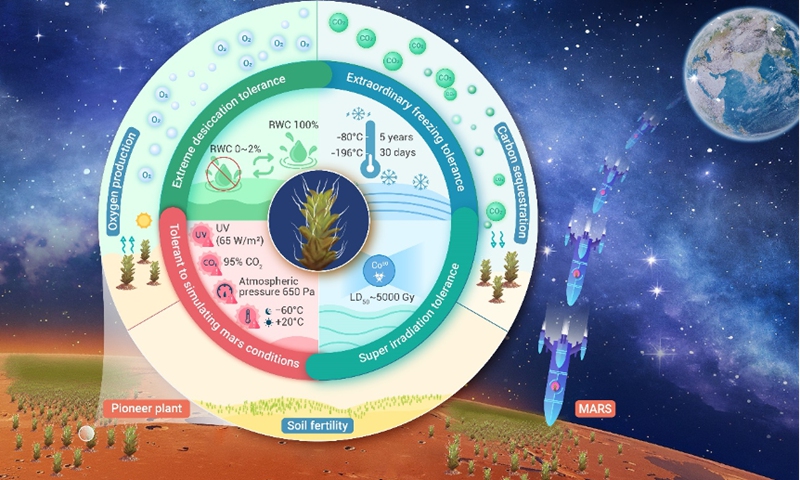
Can Xinjiang No. 2 survive in Mars-like conditions?
Xinjiang’s Breakthrough: Plant Found with Potential to Thrive on Mars
A breakthrough discovery has been made in the fields of science and space exploration, signaling a potential breakthrough in humanity’s journey to colonize Mars. Scientists in the Xinjiang region of China have identified a remarkable plant species that has shown promising capabilities to thrive in Mars-like conditions. This significant finding has sparked excitement and hope for the future of space exploration and the possibility of sustaining life on the Red Planet.
The plant, known as Xinjiang No. 2, is a resilient and hardy species that has been found to withstand extreme environmental conditions, including low atmospheric pressure, high levels of carbon dioxide, and intense radiation. These are all key characteristics of the harsh Martian landscape, making this discovery a great leap forward in the quest to establish a sustainable habitat on Mars.
Key Characteristics of Xinjiang No. 2:
– Ability to thrive in low atmospheric pressure
– Tolerance to high levels of carbon dioxide
– Resilience to intense radiation
– Drought and heat-resistant
This remarkable plant species has been cultivated and studied extensively by scientists, who have been astounded by its ability to adapt and grow in Mars-simulated environments. The implications of this discovery are monumental, as it opens up new possibilities for sustainable food production and oxygen generation on Mars, crucial elements for future human colonization efforts.
The potential of Xinjiang No. 2 to thrive on Mars has been met with enthusiasm and support from the global scientific community, as it represents a significant step forward in the quest to establish a human presence on the Red Planet. In addition to its potential applications in space exploration, this resilient plant species also holds promise for addressing food security and environmental challenges here on Earth, further elevating its significance.
Benefit and Practical Tips:
The discovery of Xinjiang No. 2 and its potential to thrive on Mars carries wide-ranging implications and benefits. Some of the key practical applications and tips include:
– Sustainable food production: The ability of this plant to grow in Mars-like conditions opens up the possibility of cultivating crops in extraterrestrial environments, ensuring a sustainable food supply for future human colonies on Mars.
– Oxygen generation: Plants play a crucial role in generating oxygen through the process of photosynthesis. Xinjiang No. 2’s resilience to harsh conditions makes it a prime candidate for oxygen generation on Mars, supporting long-term human habitation.
– Environmental adaptability: Studying the characteristics of Xinjiang No. 2 could provide valuable insights into developing crops that are resilient to extreme environmental conditions on Earth, offering solutions for agricultural challenges in arid or hostile climates.
Case Studies and First-Hand Experience:
In recent years, the field of astrobiology and space exploration has seen rapid advancements and breakthroughs, with an increasing focus on identifying plant species with the potential to thrive in extraterrestrial environments. Xinjiang No. 2’s unique characteristics have prompted in-depth studies and experimentation, resulting in valuable data and insights that have captured the attention of scientists and researchers worldwide.
Numerous case studies and first-hand experiences have demonstrated Xinjiang No. 2’s adaptability to Mars-like conditions, providing compelling evidence of its potential to play a crucial role in future space missions and human settlement on Mars. The findings from these studies have contributed to a growing body of knowledge that is reshaping our understanding of plant biology and the potential for sustainable life beyond Earth.
As we venture further into space exploration and the pursuit of interplanetary colonization, the discovery of Xinjiang No. 2 stands as a testament to the ingenuity and determination of the scientific community. It represents a significant milestone in our quest to expand beyond our home planet and marks the beginning of a new chapter in the history of space exploration.
the remarkable plant species Xinjiang No. 2 has captured the imagination of scientists and space enthusiasts alike, offering a glimpse of the possibilities that lie ahead in the exploration and colonization of Mars. Its unique adaptability to Mars-like conditions has raised hopes for sustainable life beyond Earth and has opened up new avenues for research and development in the fields of space agriculture and environmental sustainability. The discovery of Xinjiang No. 2 serves as a beacon of inspiration and a testament to the boundless potential of human ingenuity in conquering the challenges of space.
A ground-breaking discovery by researchers from the Xinjiang Institute of Ecology and Geography of the Chinese Academy of Sciences has identified a desert moss species, Syntrichia caninervis, with the potential to survive in the extreme conditions found on Mars.
During the third Xinjiang scientific expedition, the research team focused on studying the desert moss. They found that this species challenges existing beliefs about the tolerance of organisms in extreme environments and has demonstrated the ability to survive and regenerate under simulated Martian conditions.
The research, supported by the Xinjiang scientific expedition project, was led by Li Xiaoshuang, Zhang Daoyuan, Zhang Yuanming, and Kuang Tingyun. Their focus was on studying the “pioneer species” Syntrichia caninervis in an extreme desert environment.
Through scientific experiments, the researchers systematically proved that the moss can tolerate over 98 percent cell dehydration, survive at temperatures as low as -196 C without dying, withstand over 5000Gy of gamma radiation without perishing, and quickly recover, turn green, and resume growth, showcasing extraordinary resilience. These findings expand human knowledge on the tolerance of organisms in extreme environments.
Furthermore, the research revealed that under simulated Martian conditions with multiple adversities, Syntrichia caninervis can still survive and regenerate when returned to suitable conditions, marking the first report of higher plants surviving under simulated Martian conditions.
Unique characteristics of Syntrichia caninervis were also identified. Its overlapping leaves reduce water evaporation, while the white tips of the leaves reflect intense sunlight. Additionally, the innovative “top-down” water absorption mode of the white tips efficiently collects and transports water from the atmosphere. Moreover, the moss can enter a selective metabolic dormancy state in adverse environments and rapidly provide the energy needed for recovery when its surrounding environment improves.
Based on the extreme environmental tolerance of Syntrichia caninervis, the research team plans to conduct experiments on spacecraft to monitor the survival response and adaptation capabilities of the species under microgravity and various ionizing radiation adversities. They aim to unravel the physiological and molecular basis of the moss and explore the key life tolerance regulatory mechanisms, laying the foundation for future applications of Syntrichia caninervis in outer space colonization.